There are many wrongly perceived ideas surrounding vision impairment, sighted people often think that blindness means having no vision at all, therefore, everything looks completely black, but that couldn’t be further from the truth for the majority of blind and vision impaired people. According to the RNIB 93% of blind and vision impaired people can see something, just because a person has a vision impairment, it does not mean that they have no vision at all.
The question ‘so what can you actually see?’ is something that most blind and vision impaired people have been asked on numerous occasions and it probably won’t stop anytime soon, but it can be rather frustrating. There are some common questions that we’re often asked, and this is one of them. Sighted people don’t always realise that vision impairment is a spectrum, so I think it’s important to raise awareness of this.
I’m registered as blind due to a condition called Retinopathy of Prematurity as I was born at 24 weeks and weighed 624 grams. I have a detached retina in my left eye meaning that I have no useful vision in that eye, I have light perception in my right eye, meaning that I can tell the difference between light and dark, I probably use it a lot more than I realise.
I recently developed increased sensitivity to light which can affect me on a daily basis depending on the brightness.
There are millions of people in the world that have a vision impairment, and I’m only one of them. Everyone’s vision is different, we all have our own experiences of being blind or visually impaired.
I wanted to raise awareness of the spectrum of vision impairment, but I knew that this wasn’t something that I could do on my own. I took to Twitter to see if any of my blind or visually impaired followers were interested in getting involved in a blog post, and I had a huge response, way more than I ever expected!
I asked them to shed some light on their eye condition and what they can/can’t see in order for us to show society that having a vision impairment doesn’t mean that you have no useful vision, because it isn’t like that at all.
The spectrum of vision impairment
I’ve shared what I can and can’t see, but here are other blind and visually impaired people’s experiences, together we can hopefully educate people on vision impairment and break down barriers.

“I have retinopathy of prematurity or ROP for short. This was caused as I was born at 23 weeks weighing 920 g. The hospital did not cover my eyes causing my retinas to be burned. As a result of this I am completely blind and have no vision.” – Victoria
“I have Congenital Glaucoma and I’ve been considered visually impaired since birth, though I wasn’t registered blind until I was 12, and had sight until my early 20s. As a young child I could see most things up close, by the time I was 12, my sight had deteriorated, and I could only read large print. It was another 11 years before I had no sight at all. During this time, I experienced varying degrees of blindness and I struggled to differentiate between the coloured blobs that became my world during the final year I had sight. Now, I lack the ability to differentiate between light and dark, having lost the last of my sight when I was 23 years old.” – Victoria

“I have Leber’s Congenital Amaurosis, a genetic condition which means I was born with light perception only. I can tell the difference between light and dark, which doesn’t sound like much, but it means I can usually avoid large objects which block the light (although glass walls can be problematic). For the most part I have the same accessibility needs as a totally blind person, although I probably rely on my light perception more than I think and would be stuck if I lost it.” – Reanna
“I live with a condition called Retinitis Pigmentosa. I started having symptoms when I was three years old and I was diagnosed three years later with the sight-stealing disease. I was registered blind aged 12 and suffered a big deterioration in what I could see during my GCSE exams – what perfect timing! As my vision deteriorates daily, I can now see lights, colours and shapes but any detail is very limited.” – Elin

“I have retinopathy of Prematurity or ROP for short. I was born at 24 weeks and I was put on too much oxygen. Because of this I’m blind. When I walk into a room, I can scan the room and notice things like tables, chairs, people, windows etc. I have a hard time noticing smaller details such as print on a poster (I can see letters but can’t read them). It’s also hard to read facial expressions and see a person’s eye colour.” – Becca
“I have Retinitis Pigmentosa. It’s difficult to describe what I can and can’t see because my vision is very finicky. What I’m able to see depends a lot on the lighting, contrast, and context. It helps to know what I’m looking at so I can form a mental picture to fill in the gaps. Basically, I can see shapes, shadows, movement, light, and a little bit of colour but they’re very faded. I don’t have peripheral vision, so it’s kind of like I’m looking through a cereal box. I also don’t have depth perception so I can’t tell how close or far away something is, or if the ground is flat or if there’s a step.” – Cayla
“I became blind at the age of 21 as a result of diabetic retinopathy. Although I’m totally blind with no residual vision, it’s not to say I see only blackness. Usually what I see is a background that ranges in colour from rose pink to aquamarine, with tiny spots of brilliant white, gold and blue that blink in and out a little like a visible version of pins-and-needles.” – Lois
“I have glaucoma, I’ve got no vision at all in my right eye and only a little bit in my left. I’ve got a pretty narrow visual field and can perceive light from dark and some motion. What I do see is mostly like an old black and white TV unless the colour is really loud like a red car or something.” – Justin
“I have albinism with nystagmus and astigmatism. I can see light and movement. Close up, around a meter or 2 away, I can also see colours. I can only see large text close up at around 10 – 30 cm away depending on light, I see better in low light.” – Charly
“I have Retinitis Pigmentosa, which means that I also suffer from Tunnel Vision, Night Blindness and Floaters. My Vision is pretty much like looking through a Funnel, as I only have a very small amount of Central Vision so I can only see a very blurry version of what’s right in front of me. I also can’t see in the dark and every so often Floaters that look like little bits of Tissue float across my Vision whenever the lighting conditions change.” – Luke
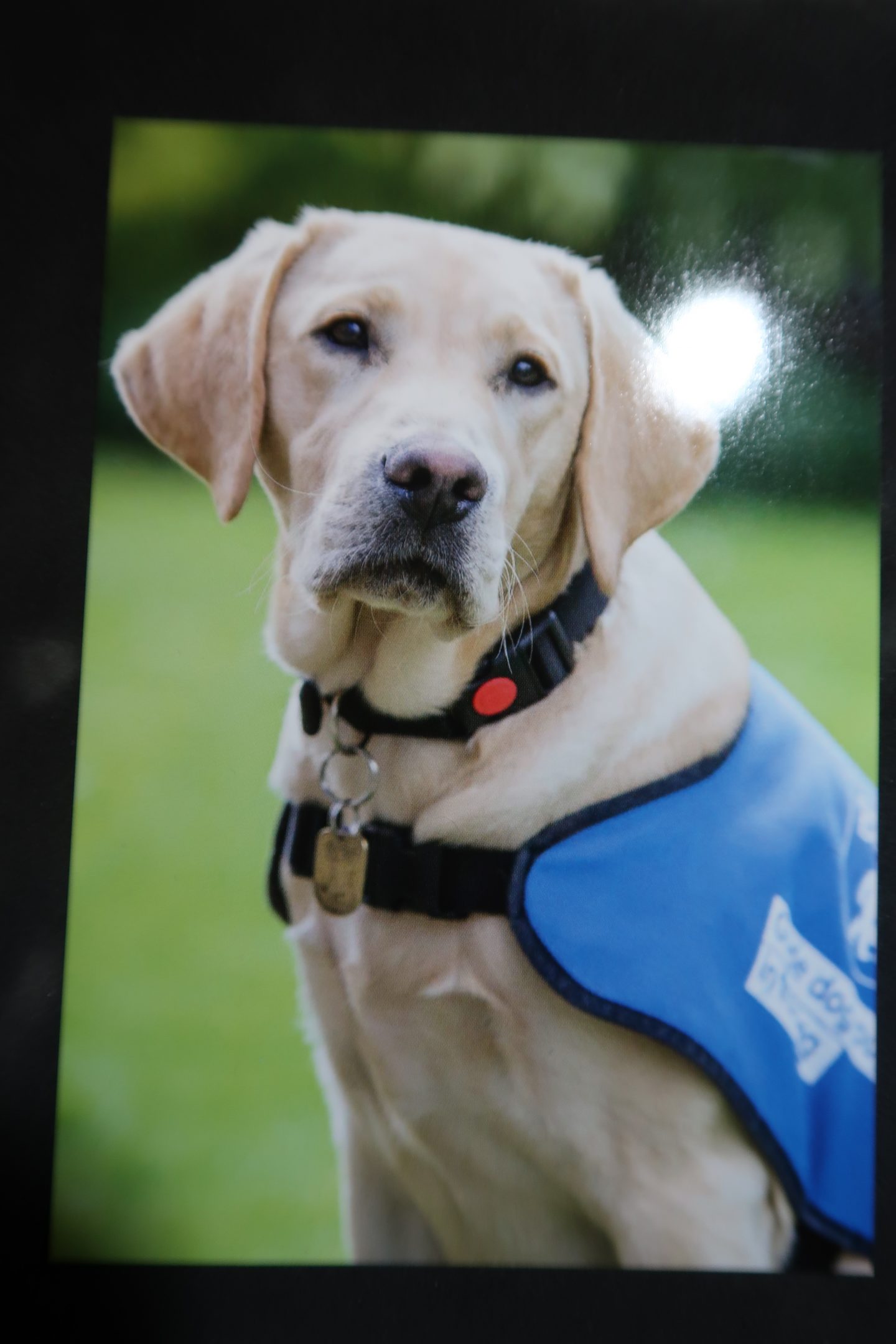
“An issue for me is that I have only been diagnosed with nystagmus and that tends to be a symptom of other conditions. In light of this, I feel that I don’t have a true diagnosis. What I see is difficult to describe because I’ve always had my sight impairment. What I can see is confusing, painful, tiring and I have to strain my eyes and my body, tilting my head at an angle to try and work out what I’m seeing. I use my imagination a lot to guess what things might look like particularly if things are far as I can see more detail when things are closer. I have a constant flicker and things appear to move when in reality they are stationary.” – Natalie
“I have a genetic condition called Hermansky Pudlak Syndrome. I also have nystagmus (involuntary eye movement). I can see, but my vision lacks detail. If a person is standing across the room, I can see their basic shape and what colour they are wearing, but I wouldn’t be able to tell who they are because I can’t see their facial features. I also have lack of depth perception and I’m highly sensitive to sunlight. I’m able to read print, but only if the font is big enough and I’m able to hold it a few inches from my face. I can’t read street signs or drive.” – Casey
“I have Retinitis Pigmentosa and what I’m not able to see is fine details amongst other things. I can’t see well in bright light and I mostly see out of my right eye. I have night blindness, and my peripheral vision is poor.” – Juan
“My vision loss is caused by a rare condition called Lebers Hereditary Optic Neuropathy (LHON). LHON affects the optic nerve and causes severe central vision loss, leaving various levels of usable peripheral vision for most. My current vision (peripheral only) is like looking through frosted glass with snowy static moving around all the time. I can see shapes, objects, contrast, and with extreme magnification I can read print. I cannot see faces, details, dimension, or most colours.” – Maria
“I have aniridia, which means I don’t have irises (the coloured circles) in my eyes. As a result, I cannot adjust to changes in light, so I’m extremely sensitive to glare and cannot see well in dim light. I also have nystagmus, which makes my eyes shake all the time, so I have poor distance vision and cannot focus on detail or text unless it’s close-up and enlarged.” – Glen
“After retinal tears and glaucoma, I have no vision in one eye and compromised peripheral vision in the other. Light sensitivity and glare render my remaining vision unreliable at times. Anything small or far away must be magnified for me to see it well. For example, things like recognizing faces, reading regular sized font, and being in certain lighting conditions is difficult.” – Susan
“I have Optic Neuropathy which means there is extensive damage to my optic nerves. This leaves me with no central vision, only my peripheral vision. If you were to stand or sit before me, then I would only be able to see parts of your face.” – Ami
“I have Ocular Albinism, my vision is like a bubble, sometimes I can see a face, or a street sign a couple of metres in front of me, but it can shrink to a couple of inches. It varies all the time depending on how tired or stressed I am, if it’s sunny or if I’m not feeling well. It can take a lot of energy to use my residual useful vision to do tasks like reading or trying to navigate a new place. I wish people would understand that vision is a spectrum & can change on a daily basis.” – Amy

“I have Visual Cortex Disorder and I am registered as partially sighted. I have a reduced peripheral vision, I’m also both long and short sighted. This means nothing I see is in focus and a significantly larger font size is needed for me to be able to read something. I would be unable to read train timetables or could bump into things. However, I would be able to tell if someone was stood in front of me and can see the outline and colours of things around me.” – Chloe
“I have stargardts disease which affects central vision. In the very centre when looking directly at something, I often see what I can only describe as a honeycomb pattern with lots of bright continuous flashing spots which can often be bright neon green, white or purple in colour. It is almost like when the TV can’t find a channel and you get all the static over the screen. When it’s dark, I have what looks like a rippling water drop sat in the middle of both eyes and in very bright lighting I can often have a white glow that looks like the after affects of when you stare at a light bulb for too long. The rest of my vision (peripheral) is the same as fully sighted peoples.” – Katie
That is just a bit of an insight into the spectrum of vision impairment. As you can tell from these responses, everyone’s vision is different, and vision can also differ even if various people have the same eye condition.
Vision is something that’s unique to every blind or vision impaired person, our experiences are all different.
If you have a vision impairment, what’s your eye condition and what can/can’t you see? Let’s keep the conversation going in the comments in order to raise even more awareness.
Thank you to everyone that took part in this blog post, unfortunately I couldn’t include everyone’s responses as the post would have been way too long, so if you would like a part two then do let me know.
Holly x

![There’s a phrase we hear far too often: “fully accessible”.
Hotels use it. Venues use it. Website developers use it. Event organisers use it.
On the surface, it sounds brilliant. But there’s no one size fits all approach to accessibility.
Because accessibility isn’t a box you can tick once and forget about. There isn’t a magic point where something becomes accessible to every single disabled person.
Our access needs are different. What works for one person might not work for another.
Rather than asking, “is it accessible?”
Ask: “Accessible for who?”
In my latest blog post, I’m exploring why “fully accessible” is a myth. Head to the link in my bio if you’d like to give it a read.
[Image descriptions:
Image one: Holly stood on a pier, leaning against a railing by a sandy beach with the sea in the background. She wears a black T-shirt, a skirt with a colourful floral pattern, a silver necklace and glasses.
Image two: Holly sat on a low stone wall beside a shallow stream with a path running alongside it. Dense green bushes and trees line the far bank, forming a thick hedge along the water. There is a small bridge and a building in the background. She wears a black T-shirt, a long, multicoloured patterned floral skirt and a silver necklace.]](https://lifeofablindgirl.com/wp-content/plugins/instagram-feed/img/placeholder.png)
Great helpful insightful post
Thank you
I have a condition which is often difficult to pronounce. My condition is, you ready for it? Lenz Microphthalmia which means small features. I only have light perception and that’s it I get asked how much I can see and my answer is that I can only see light or feel the sun when it’s out
I’ve never heard of that so I learnt something new, thank you for joining in the conversation
this condition also ended up being that I had a kidney condition too. I ahd small kidneys which as I grew my kidneys never grew when I did
I was born with retinoblastoma and lost my right eye due to that. At 36 I was diagnosed with merkel cell carcinoma on my left eye lid which led to multiple surgeries and radiation therapy. These led to severe dry eye disease and trichiasis, which means my eyelashes grow in the wrong way, causing many corneal scratches, ulcers, and infections over the next several years. As a result from all this damage, I became legally blind at age 48. My vision fluctuates depending on light conditions. I am very photophobic so even on overcast days I use sunglasses. I can navigate pretty well mostly but my depth perception is not great. I can read large print if there’s enough contrast. I can’t see people’s facial expressions and unless they are standing close to me I can’t tell who they are. And, alas, no more driving of course.
This is a great blog post- very informative for all!
Thank you. Ahh wow, very interesting, thank you for sharing
Hi,
I have congenital optic nerve damage (maybe described by the term ‘neuropathy’, maybe not?), nystagmus, strabismus, and astigmatism on top of myopia. I have no natural depth perception, and since the prenatal brain damage that caused this also gave me mild cerebral palsy on my left side, I’m very bad at balancing — going up and especially down stairs without a handrail is hard.
I do not drive.
But I am not legally blind. My acuity is 20/70 in my worse eye with correction.
I do have to explain to people that my (very heavy prescription) glasses do not correct my vision to 20/20, that there are other eye conditions beyond myopia.
As for what I can see — the lack of depth perception is a sensation of losing balance and being about to fall forward or backward, not extra colors or lack of colors in my visual field.
This is all really interesting, thank you so much for sharing
I was born with bilateral congenital cataracts and developed glaucoma as a complication of surgery. Thanks for writing this article and helping to raise awareness!
Thank you, thank you so much for joining in the conversation
I have myopic macular degeneration, which is similar to wet age-related macular degeneration, except mine is caused from strain to my retina as a result of being extremely near-sighted. It causes my eyes to produce abnormal blood vessels that leak into my eye, and when that happens my visual acuity can fall into the “legally blind” threshold. I receive injections to treat some of the symptoms, but there is always some residual damage to my central vision. I have a 50/50 chance of becoming permanently legally blind, and it could happen over time or instantly.
Thank you so much for joining in the conversation
In my left eye, I had a macular hole as the result of a car accident at the age of 37, which took my central vision. About 18 months after my cataract surgery on both eyes ( 5 years after the macular hole), I had a posterior vitreous detachment with retinal tear/bleed in my right eye, which left me with a huge floater in my right eye that sometimes positions itself in my central vision, making it grey out and blurry. The tear reopened about 5 months later and I ended up losing some of my peripheral vision. I have a lot of floaters in both eyes, my depth perception is not good, I can’t see close up very well, but my distance vision is 20/40 corrected in my good eye and I am still able to drive during the day. I have nystagmus in my right eye and some days my vision is better than others. My brain comes up with some really interesting things it sees to compensate. I can’t always see faces or fine detail and I can’t read anything close up, unless it is magnified. I find it really hard to explain to people what I do see, as it’s not the same all the time. My doctors can’t really explain why my vision is the way it is, no one else in my family has these issues and I have never met anyone else with similar issues.
Sounds like you went through a lot! Thank you so much for sharing
Excellent.
Thank you!
HI Holly, thank you so much for a great read as always.
To take the conversation further.. I have an eye condition called retinopathy of prematurity due to being born at 24 weeks. I have a detached retina in my right eye.
I cannot see anything from my right eye.
I have light perception in my left eye which means I can differentiate between light and dark. I can also make out someone standing or something in front of me like a wall since it blocks the path of light however, I cannot see who that person is. I can also make out reflections.
To take an example, I can see light reflected through a tabletop made up of glass.
Since usually light reflects on white surfaces like paper, I can usually make out something kept in front of me like a piece of paper when it is under light.
Thank you, really glad you enjoyed reading. Thank you so much for joining in the conversation
Great post. Cute pictures of the dogs.
Thank you
Hi Holly, great post! I have Nystagmus and Astigmatism, and I’m am registrars blind. I am going to for an eye test in a few weeks to check all okay. I think I am developing some increased sensitivity to sunlight – just this morning I was walking to get a train and I couldn’t see anything for a good few mins because of the sun and how bright it was. Do you think this is worth mentioning or is it nothing to worry about?
Thank you. Thank you for sharing your vision to help raise awareness. Personally I would mention it just in case, they might give you some advice. I hope it goes well
A very insightful post which I’m sure will help to raise a lot of awareness of different eye conditions. Loved getting involved with this xxx