One of the main aims of my blog is to tackle the common misconceptions and stigmas surrounding vision impairment and disability in order to raise awareness of the challenges we face, also to educate society to hopefully create change.
Employment is a topic that can be a sensitive subject for many disabled people, it can bring challenges and it can also bring pride and gratitude. Everyone’s experiences of employment are unique and everyone feels a different way about it, we’re all at different stages of our employment journey – whether you’re still figuring out what you want to do, actively looking for a job or are in employment, we all go on our own journey. One thing that I’m sure we can all agree on is that finding a job can be difficult, especially when you have a disability.
The working world is so diverse, but diversity and equality can be overlooked when it comes to employment for disabled people.
It’s 2019, you would like to think that disability would be accepted in all aspects of society, sadly this is often not the case, especially in regards to employment.
Getting a job can be difficult. It could be argued that disabled people face even more barriers when trying to secure work.
Why is that the case?
Employers often have outdated attitudes on disability, this means that disabled people face barriers straight away. Research by the disability charity Scope found that 85% of disabled people feel that employer attitudes haven’t changed over the last four years.
When that box ‘do you have a disability?’ Is ticked on an application form, employers sometimes disregard disabled people’s applications, meaning that disabled people are denied the opportunity of showing what they’re capable of, just because of their disability. There is a debate whether we should tick that box and disclose our disability or not, this is something that’s personal to everyone. Personally, I have always ticked that box and tried to demonstrate the skills my disability has given me and portray my disability in a positive light. I know that not all employers look beyond that box, therefore, they don’t see beyond a person’s disability.
It shouldn’t be like that.
Employment is a topic that I would like to discuss more on my blog. I shared some top tips on looking for a job when you have a disability, I think it’s important to highlight this topic now more than ever.
With that in mind, I thought that I would bust some myths on disability and employment. I know that this won’t change disability and employment as a whole, but if it makes even one employer change their attitudes on disability, then that’s a step in the right direction.
Let’s bust some myths on disability and employment, shall we?
Disability means a physical disability
Oh definitely not. There is a range of disabilities and not all of them are visible either, we can’t forget about invisible disabilities and chronic illnesses.
The 2010 Equality Act states that a disability is “a physical or mental impairment that has a substantial or long-term negative effect on your ability to do normal daily activities.”
This states that not all disabilities are physical and that there are in fact, a vast number of disabilities.
Disabled people aren’t capable of holding down a job
We are often perceived to be incapable of doing many things, holding down a job being one of them. When we do so, we are seen as inspiring.
Let’s get the facts straight, disabled people can work, we can hold down a good job and we are most certainly capable of doing so.
We may need adaptions but this isn’t a bad thing as they enable us to do the job to the same standard as non-disabled people.
We will stay in the same job forever
We won’t stay in a job forever because we are so grateful for that job, and that someone has given us a chance.
We applied for the job like everyone else – it fit our skills and interests and experience. We live life like non-disabled people and will get a new job when the time is right.
We want to move up the career ladder, we want to succeed.
Having a disability doesn’t take away changes in our lives.
Disabled people don’t want to work
Why wouldn’t we want to get a job?
Our disability doesn’t mean that we have glamorous lives where we don’t need or want to work. Having a disability doesn’t stop us from having the desire to work or take away our aspiration to achieve, succeed and get a job that we enjoy and that we are good at.
I don’t know a disabled person that doesn’t want to work. We want to work and contribute to society.

Disabled people only work within the disability sector
Having a disability makes you an expert in that disability, yet it doesn’t mean that you want to work in that field, or have to work in that field. Yes, disabled people do work in the disability sector (myself included). That’s because we have an interest in that area, not because we have a disability so it’s the only sector we can get a job in.
Disabled people can work in a variety of roles, the list is endless.
A disabled employee is unlikely to contribute as much as a non-disabled employee
With the right adjustments, adaptions and support, there is no reason that disabled employees can’t contribute as much as a non-disabled employee.
Disabled people are overlooked. Employers are missing out on potential talent.
It is expensive to employ a disabled person
Employers should provide reasonable adjustments for disabled employees, many of these aren’t expensive.
Schemes such as Access to Work provide help and support such as specialist equipment and assistive technology, help with travel costs for commuting, and also mental health support.
These schemes enable disabled people to carry out their job like non-disabled people and also help employers provide reasonable adjustments.
Disabled people have a higher absentee record than non-disabled employees
Having a disability doesn’t mean that we are off sick all the time. If we need time off due to our disability then reasonable adjustments should be put in place.
Disabled people need constant support
With the right adjustments and support, disabled people can work independently.
Some disabled people may choose to have a support worker which can be put in place through schemes such as Access to work, but this is simply to help them with tasks they may struggle with because of their disability, not do the job for them.
Personally, I don’t have a Support Worker in my current role, that’s my personal choice because I don’t feel I need one.
Employees may feel uncomfortable around disabled people
Everyone feels uncomfortable around people they don’t know at first, add a disability into the mix and things may or may not be challenging, it’s different for everyone.
Non-disabled people may be scared of saying or doing the wrong things. Once everyone gets to know each other, you start to learn about disability, and you quickly learn the do’s and don’ts.
In reality, disabled people can feel uncomfortable as well.
When I started my job, I was nervous, there were times when I may have felt uncomfortable. I’m pretty sure that it was the same for my sighted colleagues. I got to know them and they got to know me. Many of them aren’t just my colleagues anymore, they’re my friends. They soon realised when I needed help and when I didn’t. Most importantly they saw me for the person I am, not just my disability.
Companies should be diverse, just like the real world.
Disabled people are unable to meet performance standards
This is nothing to do with a person’s disability. It could be argued that this is why reasonable adjustments are so important, as they mean that disabled people can perform to the same standards as non-disabled people.
There are no stereotypes
Why is it when disabled people tick that box and disclose their disability, they are overlooked, their skills aren’t taken into account and they aren’t considered for the job? Why do employers assume the myths mentioned above?
Disabled people aren’t always seen as equal. If you think about it, there are always stereotypes in many aspects of society. Research by the RNIB found that 35% of blind and vision impaired people sometimes, frequently or always face negative attitudes from the public in regards to their vision impairment. These negative attitudes from the public can then transpire into employment or education for example. This statistic shows that there are still stereotypes in the society we live in. We need to ask ourselves: why isn’t disability normalised in society?
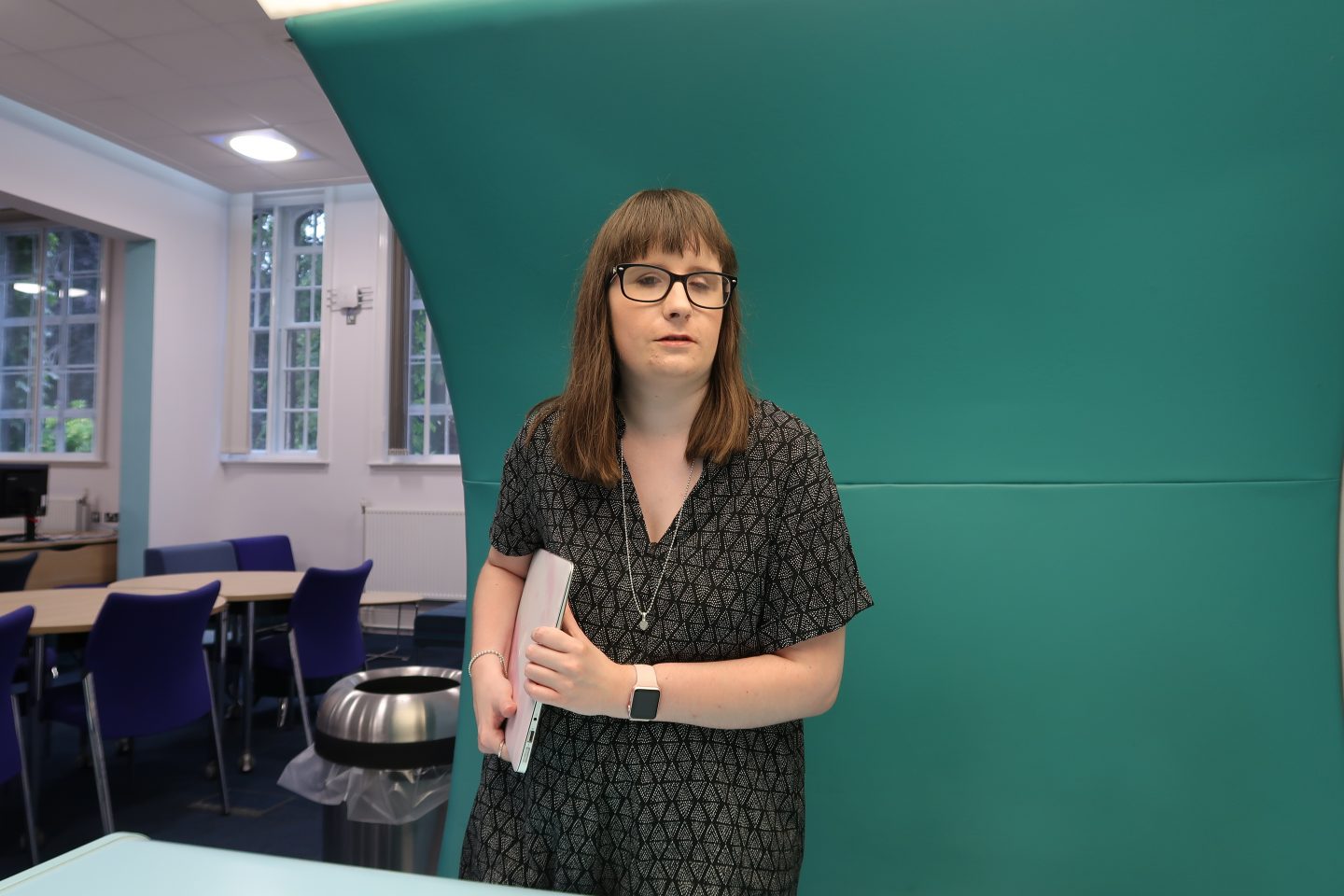
I know that there are many employers that have positive attitudes towards disability, they employ disabled people for their skills and experience, and provide reasonable adjustments. We should shout about these employers because they deserve to be celebrated! They don’t treat us differently to anyone else and are inclusive. I’m extremely grateful to work for an employer that sees my skills, my talent and passion for what I do.
I know that there are also employers that aren’t that positive and don’t see a disabled person for their skills, talents and abilities, so I think busting myths surrounding disability and employment is extremely important.
All disabled people want is a chance. If a disabled person applies for a job, they fit the criteria and you’re wondering if to give them a chance or not, ask yourself one question: what’s stopping me from doing so? You may have doubts and worries which can be dealt with over time.
Disabled people want to work, we deserve to work and we shouldn’t be living in a society where we are seen as unequal, incapable and inadequate.
Disabled people can succeed. We can be managers, run a successful business, we can do the things that we set our minds to. Yes, we may have some limitations, I’m blind and there are certain things that I can’t do. That doesn’t take away my vision to succeed and achieve.
You don’t need sight to have vision.
See the person, not the disability.
Are there any other myths surrounding disability and employment that you would like to bust? Let me know in the comments.
Holly x

![There’s a phrase we hear far too often: “fully accessible”.
Hotels use it. Venues use it. Website developers use it. Event organisers use it.
On the surface, it sounds brilliant. But there’s no one size fits all approach to accessibility.
Because accessibility isn’t a box you can tick once and forget about. There isn’t a magic point where something becomes accessible to every single disabled person.
Our access needs are different. What works for one person might not work for another.
Rather than asking, “is it accessible?”
Ask: “Accessible for who?”
In my latest blog post, I’m exploring why “fully accessible” is a myth. Head to the link in my bio if you’d like to give it a read.
[Image descriptions:
Image one: Holly stood on a pier, leaning against a railing by a sandy beach with the sea in the background. She wears a black T-shirt, a skirt with a colourful floral pattern, a silver necklace and glasses.
Image two: Holly sat on a low stone wall beside a shallow stream with a path running alongside it. Dense green bushes and trees line the far bank, forming a thick hedge along the water. There is a small bridge and a building in the background. She wears a black T-shirt, a long, multicoloured patterned floral skirt and a silver necklace.]](https://lifeofablindgirl.com/wp-content/plugins/instagram-feed/img/placeholder.png)
My disability is deafness and I have had many things that have discriminated me, or misunderstandings about my deafness.
One being “I don’t sound deaf,” when it came to my speech. As I have pointed out to people, I am a late-deafened person. So as I required my deafness later, means I have perfect speech.
Also, because I don’t sound deaf, then people don’t think I am deaf.
I wear hearing aids and again, people assume it will give me perfect hearing, when it only assists me. I still rely on seeing your face to lipread some of the conversation and observe your facial and body expressions.
Going onto lipreading, odd times people will ask, can you lipread people at a distance? No, it’s difficult and even if I could, I am not going to nosy in on two strangers who are having a conversation, that I do not know, or not sitting in on. It’s rude.
People assume I sign because I am deaf too. I don’t.
That all must be extremely frustrating! Thank you so much for sharing and for being so open and honest, I’m sure it’ll help many people understand what it’s like to live with a hearing impairment and hopefully not to make assumptions like that in the future
Good article! You made some good points. One myth I wish, employers in the States, would understand is that screen readers I use are not costly and the employers would not have to buy them.
The fact is I can get help getting the screen reader free of costs via a program called Vocational Rehabilitation- Which is like access to work. Because Vocational Rehabilitation would buy the software for me it wouldn’t cost the employers a dime.
Thank you. Yes employers definitely need to understand that reasonable adjustments can be easily put in place
Everything you’ve said in this post is what I’ve always been thinking and you’ve pretty much read my mind here as a lot of this I couldn’t have said better myself. I’ve always said that it’s difficult to find employment whether you have a disability or not but I was told that things would be easier second time around when I had my job and the end of the contract I was under was approaching the uncertainty is what makes a person anxcious note that I had no idea I was on a 12 month contract to begin with but employment agencies are notorious for giving potential job seekers false hope and they try to penalise people with disabilities if they don’t comply with their monthly obligations I had a situation where the employment agency I was with for almost 5 years were trying to threaten that I would be exited out of their system if I didn’t comply by taking my resume around to employers so to use intimidation I feel is misconduct and I should have had the right to call it out but ultimately, the employer has the last word and if the answer is no then it’s the agency that asks the questions as taking them to court and fighting the perceived discrimination will limit one’s chances of getting a job because an employer if questioned will deny it so it’s not worth fighting in court.
Thank you so much, really glad you agree. Oh that all sounds horrible and extremely frustrating, sorry you had to go through that
Theres an update since my previous comment
Ive been with a particular Disability Employment service provider for not even 6 months and theyre already saying they cant put me into placement anywhere as there are too many barriers and as a voluntary client although i want to job search im not obliged to do anything
There will be further updates in time
I’m so sorry to hear that, that’s awful and makes me really frustrated and sad! I’m sure you have the skills and knowledge, I really hope you’re able to find something
I just wrote a very lengty letter to my local mp and when a friend of mine payed closer attention to my employment agency termination letter the question came up as to whether employment agencies have their own letterhead or whether they always use a government letterhead
The letter was just a standard job seeker notification template they just added to
They are paid by the government to assist job seekers and with this letter a government letterhead has been used unbeknownst to the government
That’s great that you’ve wrote to your MP and addressing the issues
Since I work part time from home, because I have other health issues as well as my disability, so it’s what works best for me, the biggest issue I face – and it’s one I face a lot – is people assuming that my being home most of the time means I’m obviously just sitting at home twiddling my thumbs, and not doing anything important. They’ll either keep disturbing me with phone calls, arrange to come at certain times and keep me hanging around all day waiting for them, or ask me to do things for them since I’m apparently not busy. When I say something to them about it, the usual response is along the lines of, “You’re at home all day, so it doesn’t matter,” or “It’s not like you have anything else to do.” I know it’s an issue non-disabled people who work from home face too though.
My brother (also blind) doesn’t have the other health issues too, so he does go out to work. Despite having been to Cambridge University, and being qualified to be a teacher, he still struggled to find a job. He ended up working in other areas instead, and even then found it hard to get a job… Even after he had to change jobs, went to apply for a similar type to the one he’d had, and had about eight years experience in the previous job as evidence he was capable. The most frustrating was when he applied for a job working with helping blind people, was told he wasn’t going to get it because having lost his sight so young, he wouldn’t remember how it felt, so he was, “The wrong kind of blind,” and then the job went to a sighted person.
That all sounds extremely frustrating, both for you and your brother. People definitely need to realise that you can work from home and still be busy and they most certainly need to understand that there is a spectrum of sight. Your brother’s blindness shouldn’t have been the reason he didn’t get the job, that’s extremely unfair! Thank you so much for sharing
Another great post, you made some really good points hun and I completely agree with everything you said. I always disclose my disability on an application form because I feel better knowing it’s out in the open in that first step but I still worry that I’ll be denied the opportunity to show what I can give just because I’ve ticked that box. Hopefully employers will start to gain a better understanding of disability soon and start to realise how much a disabled person could bring to the role xxx
Thank you lovely! Yes I’m exactly the same, let’s hope they do xxx